Nebius Group N.V.
NASDAQ (Nasdaq-100 component) · NBIS · Netherlands
Executive summary
Nebius Group N.V. is an Amsterdam-headquartered technology company that designs, builds, and operates full-stack artificial-intelligence (AI) cloud infrastructure. It sits within the emerging “neocloud” category specialist providers that rent high-performance GPU compute to AI developers, enterprises, and hyperscalers, positioning themselves as focused alternatives to the general-purpose hyperscale clouds (Amazon Web Services, Microsoft Azure, and Google Cloud). Nebius describes itself as building “the full-stack platform for developers and companies to take charge of their AI future from data and model training to production deployment.” In practice this means it owns and operates large-scale GPU clusters, layers a purpose-built cloud software stack on top, and increasingly offers managed inference, agentic, and developer tooling above the raw compute. The company makes money principally by selling access to GPU-based compute capacity, generally under multi-year contracts with large, creditworthy customers, supplemented by shorter-term, on-demand and reserved cloud consumption from AI-native startups and digital enterprises. Revenue is recognized as capacity is delivered and consumed; management’s headline forward metric is annualized run-rate revenue (ARR), calculated as the final month’s AI-cloud revenue in a quarter multiplied by twelve. Deal economics are unusually large by cloud-software standards: Nebius has signed a contract with Microsoft valued at up to $19.4 billion and an infrastructure agreement with Meta worth up to approximately $27 billion, giving it a contracted revenue backlog exceeding $40 billion before counting on-demand demand. Nebius operates a rapidly expanding global data-center footprint. In roughly three quarters it went from a single site in Finland to multiple locations across Europe, the United States, and the Middle East, and it is now developing a series of large “AI factories,” including a 1.2 GW proprietary facility in Pennsylvania, a large campus in the U.S. Midwest, and expansions in Finland and France. The economics of the business are therefore driven less by traditional software metrics and more by physical scale: contracted and connected electrical power (measured in megawatts and gigawatts), GPU fleet size, and the pace at which contracted capacity can be converted into revenue-generating active capacity.
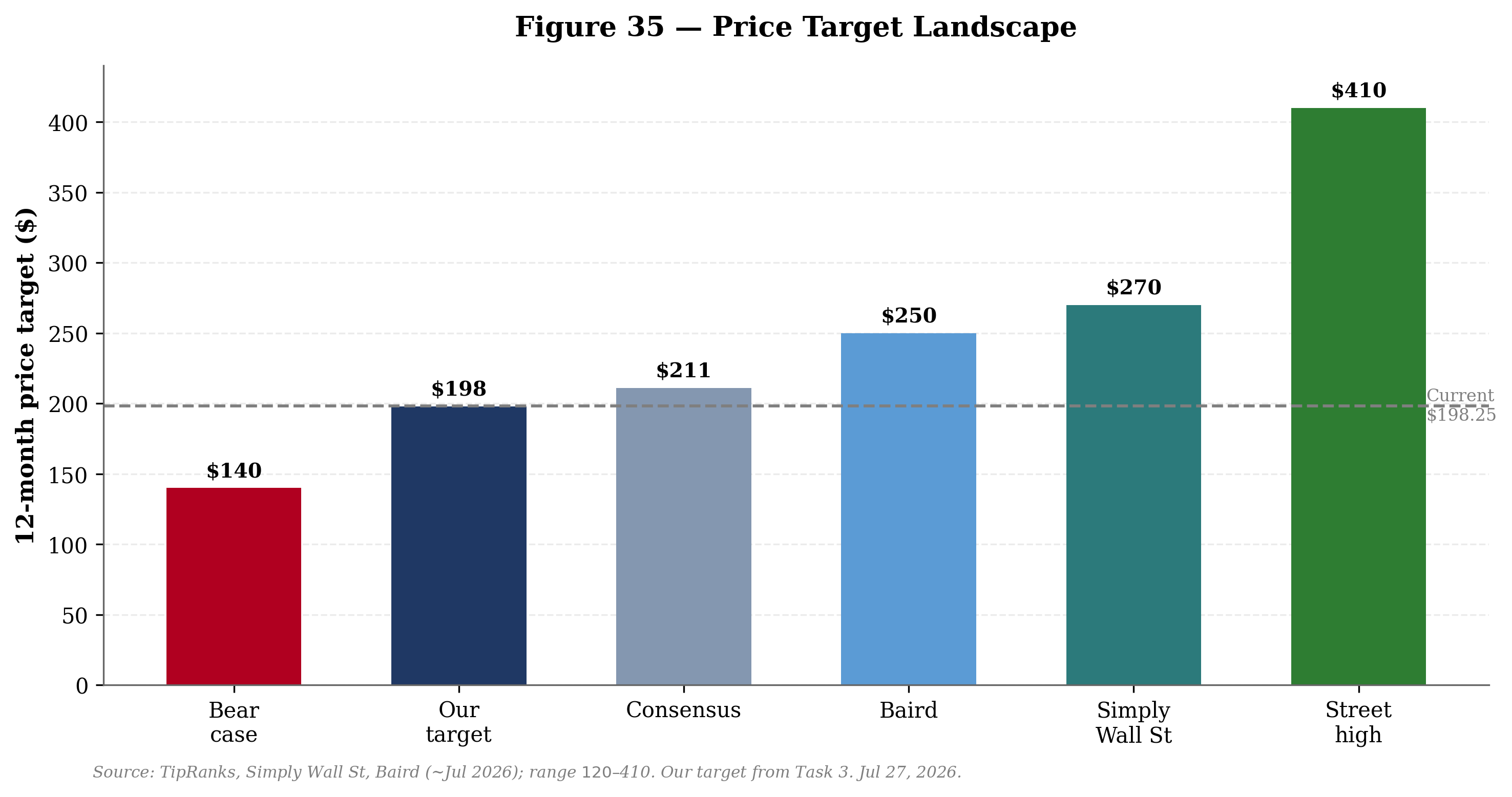
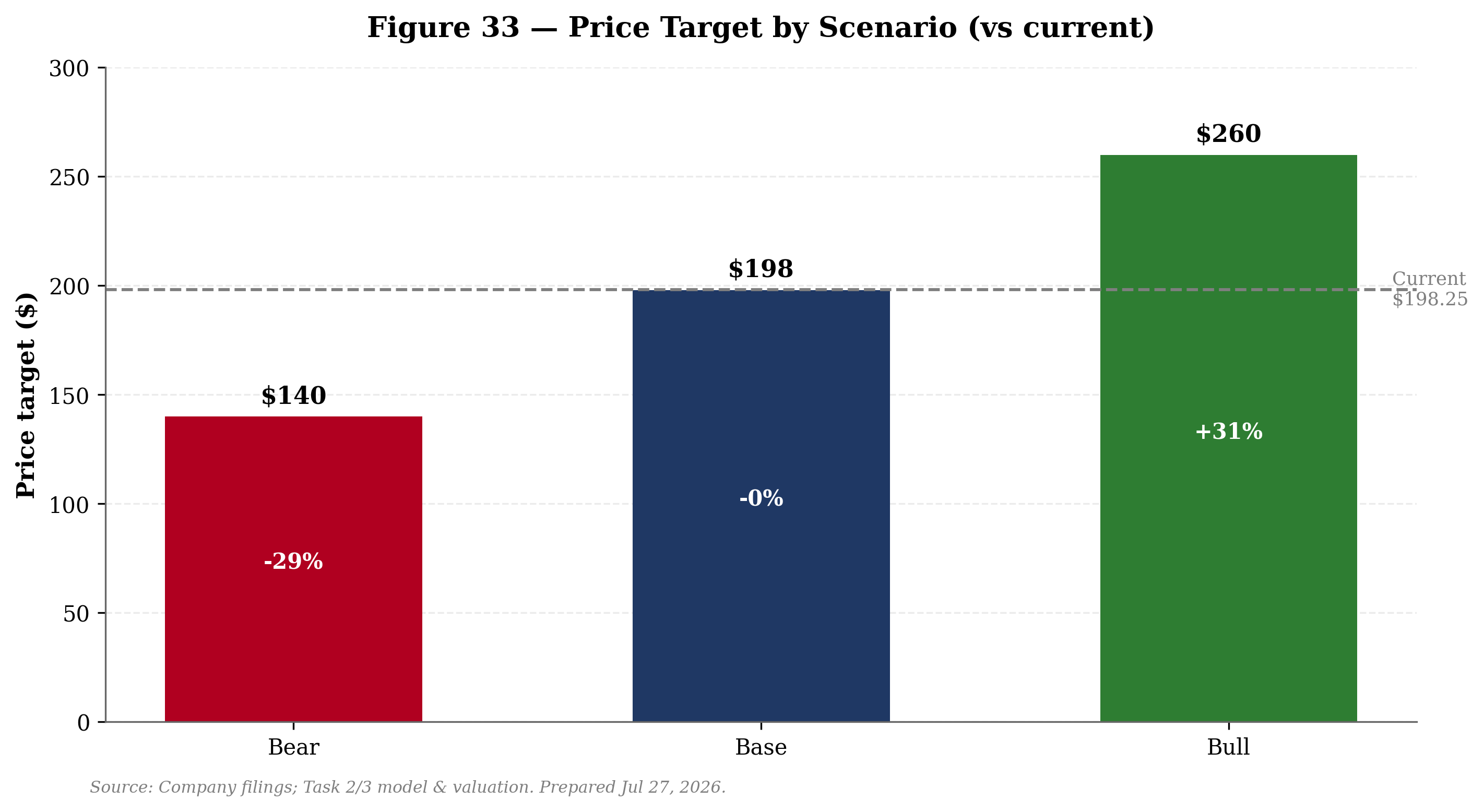
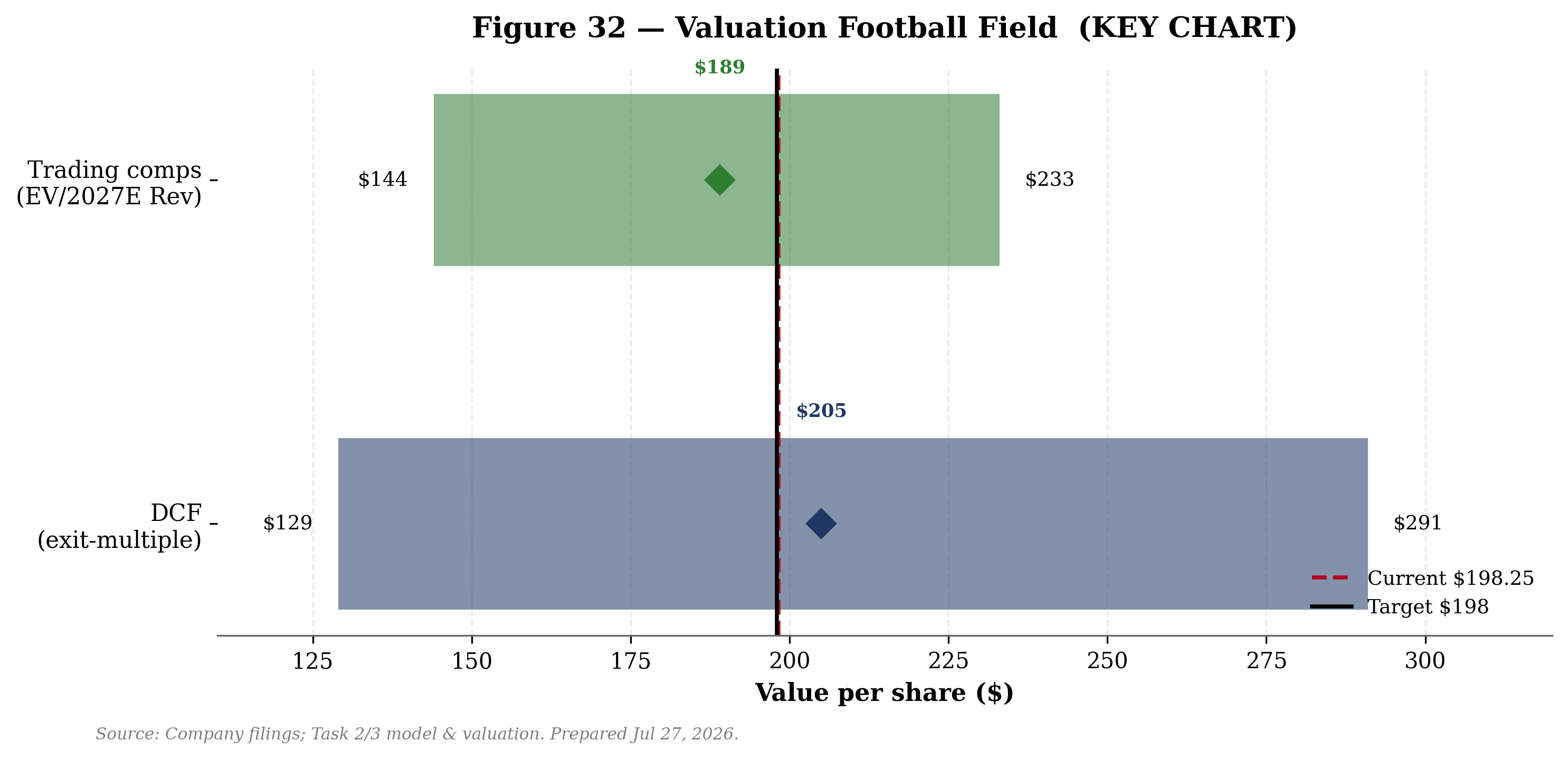
- ▪We rate Nebius NEUTRAL (Hold) with a $198-month target. This is not a negative view of the business. Nebius is among the highest-quality, best-financed independent AI-infrastructure platforms, with genuine full-stack differentiation and a powerful NVIDIA relationship. It is a statement about price: after a 262% run, the base case is already in the stock, and the payoff is skewed by an unusually wide, terminal-dependent value distribution. We would move to Buy on a pullback toward the $150s, or on hard evidence that the asset-light pivot structurally lifts free cash flow (which would raise our DCF materially), and to a more cautious stance if customer-concentration or financing risks crystallize.
Key exhibits
Risks
- ▪Vertical integration by customers: Hyperscalers self-building or reselling excess capacity could compress third-party demand and pricing.
- ▪Competitive intensity: Intense competition from larger competitors like CoreWeave and other well-funded neoclouds pressures pricing and market share.
- ▪Commoditization of GPU rental: Raw GPU-as-a-service risks becoming a commodity, compressing compute margins if software differentiation fails.
- ▪Regulatory, power, and geopolitical factors: Advanced-chip export controls, data-center power constraints, and heritage considerations impact expansion velocity.
- ▪Capital intensity and GAAP unprofitability: Massive capex outpaces current revenue, while large non-cash valuation swings continue to distort reported net income.
- ▪Financing and refinancing risk: Heavy reliance on debt and convertibles creates a systemic refinancing wall if credit conditions tighten.
- ▪Shareholder dilution: Ongoing equity issuance and a rising share count risk diluting existing holders.
Catalysts
- ▪Q2 2026 results (July 28, 2026). A beat-and-raise on revenue/ARR or another large contract could re-rate the shares; the print lands the day after this note.
- ▪Asset-light FCF inflection. If facility financing and ownership shift to infrastructure partners as announced, capital intensity falls and free cash flow improves , resulting in a direct uplift to our DCF, which currently assumes a heavy on-balance-sheet build.
- ▪New hyperscaler / frontier-lab contracts. Additional multi-billion-dollar capacity deals (beyond Microsoft and Meta) would extend the backlog and diversify concentration.
- ▪• Non-core monetization. Further value crystallization in ClickHouse, Toloka or Avride provides non-dilutive capital and optionality not captured in our base case.
- ▪Index / ownership tailwinds. Recent Nasdaq-100 inclusion and NVIDIA’s ~9.3% stake broaden the institutional ownership base.
Downloads
Full initiation report, the fully-linked Excel model, and the source repository.
Independent research for informational and educational purposes only; not investment advice or a solicitation. See the full disclaimer & methodology.